


Canada Seeks Innovative EU Partnership, Not Membership
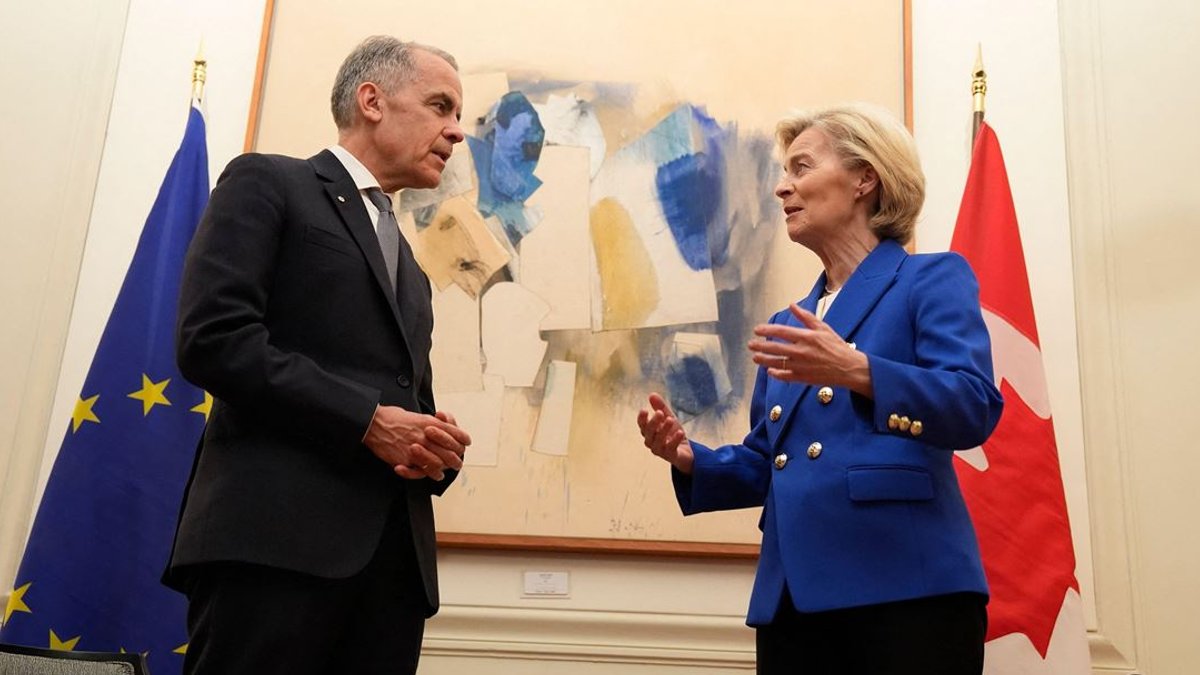
Prime Minister Mark Carney has announced an end to the latest round of trade negotiations with the United States and the pursuit of retaliatory tariffs. He also stated that Canada would begin discussions with the European Union to build a stronger security and economic partnership.
Carney’s remarks sparked speculation about Canada joining the EU. However, both the Canadian government and the European Commission have not indicated that formal accession is under consideration. Carney himself stated that membership is not the pathway Canada is pursuing.
A new model of integration
With Carney attending the State of the European Union address and the EU-Canada summit, the focus is on constructing a new model of integration rather than enlargement. Carney previously described this shift as a “diversification” and a “hedge against uncertainty” due to a confrontational Washington.
Canada’s trade with the United States accounts for 76% of its foreign trade, compared to 8% with the EU. This imbalance makes it challenging for Canada to follow the path of non-member states like Norway or Switzerland, which have integrated closely into the European Economic Area (EEA).
Joining the EEA would supersede Canada’s existing trade agreements, according to political scientist Achif Hurrelmann. Even a significant reorientation towards Europe wouldn’t replace the U.S. market. Stéphane Dion, former head of the Liberal Party, suggests that Canada could reduce its trade share with the U.S. to 50-60%.
The EU favors a slower, more informal integration path. Thomas Verellen, a professor of European law, notes that Europe lacks understanding of Canada’s decentralized structure. Political scientist Johannes Müller Gómez highlights the potential challenges of Canada’s accession, given the EU’s decision-making processes.
Sector-by-sector approach
Canada and the EU are taking steps towards deeper cooperation. Infrastructure projects, such as the liquid natural gas deal between Ottawa and the German energy company SEFE, aim to shift Canadian trade towards Europe. Canada has joined the EU’s defense initiative, SAFE, and partnered with the European Investment Bank for rare earth mineral extraction.
The sector-by-sector approach allows new agreements to build on existing frameworks without requiring full arrangements. The Full Economic Trade Agreement (CETA) between Canada and the EU, signed in 2016, provides a structure for deeper cooperation, even if only partially ratified.
Verellen suggests that over time, Canada could achieve quasi-membership through sectoral cooperation in minerals, defense, and the service economy. In 2024, Canada and the EU agreed on reciprocal standards for architecture certifications, enabling professionals to retain credentials across borders.
The rapprochement extends beyond trade and defense. The Canadian Broadcasting Corporation joined the European Broadcaster’s Union, strengthening collaboration on trusted journalism, platform accountability, and content exchange.
Challenges remain, particularly in the Arctic, where Canada views large sections as its sovereign territory and resists EU involvement. Agricultural competition is another concern, with French and Canadian dairy farmers opposing completely free trade.
Canada’s shift towards Europe is evident in recent agreements. In February, Canada joined the EU’s defense initiative, SAFE. In March, it partnered with the European Investment Bank to expand rare earth mineral extraction. In June, Canada signed a deal to purchase submarines from a German company, solidifying defense ties.
The service economy offers further cooperation opportunities. Under CETA, reciprocal standards for architecture certifications were established. Verellen suggests similar arrangements for engineers, doctors, nurses, and computer scientists, leveraging existing frameworks without full EU or EEA membership.
Cultural and media collaboration is also deepening. The Canadian Broadcasting Corporation (CBC) joined the European Broadcaster’s Union (EBU) after being an associate member since 1950. Claire Rainford, EBU spokesperson, stated the move was unanimously approved, recognizing the value of stronger collaboration on journalism, accountability, and content exchange.
Despite progress, tensions exist. The Arctic is a point of contention, with Canada asserting sovereignty and resisting EU involvement. In 2009, Ottawa blocked the EU’s Arctic Council bid over a seal product embargo. The Northwest Passage’s status is another dispute, with Canada claiming sovereignty and the EU advocating for international waters.
Agricultural competition poses challenges, particularly for dairy farmers in France and Canada, who oppose free trade. These issues highlight the complexity of balancing mutual interests with domestic priorities.

Meloni's Italy: Stability, but economic reforms lag


